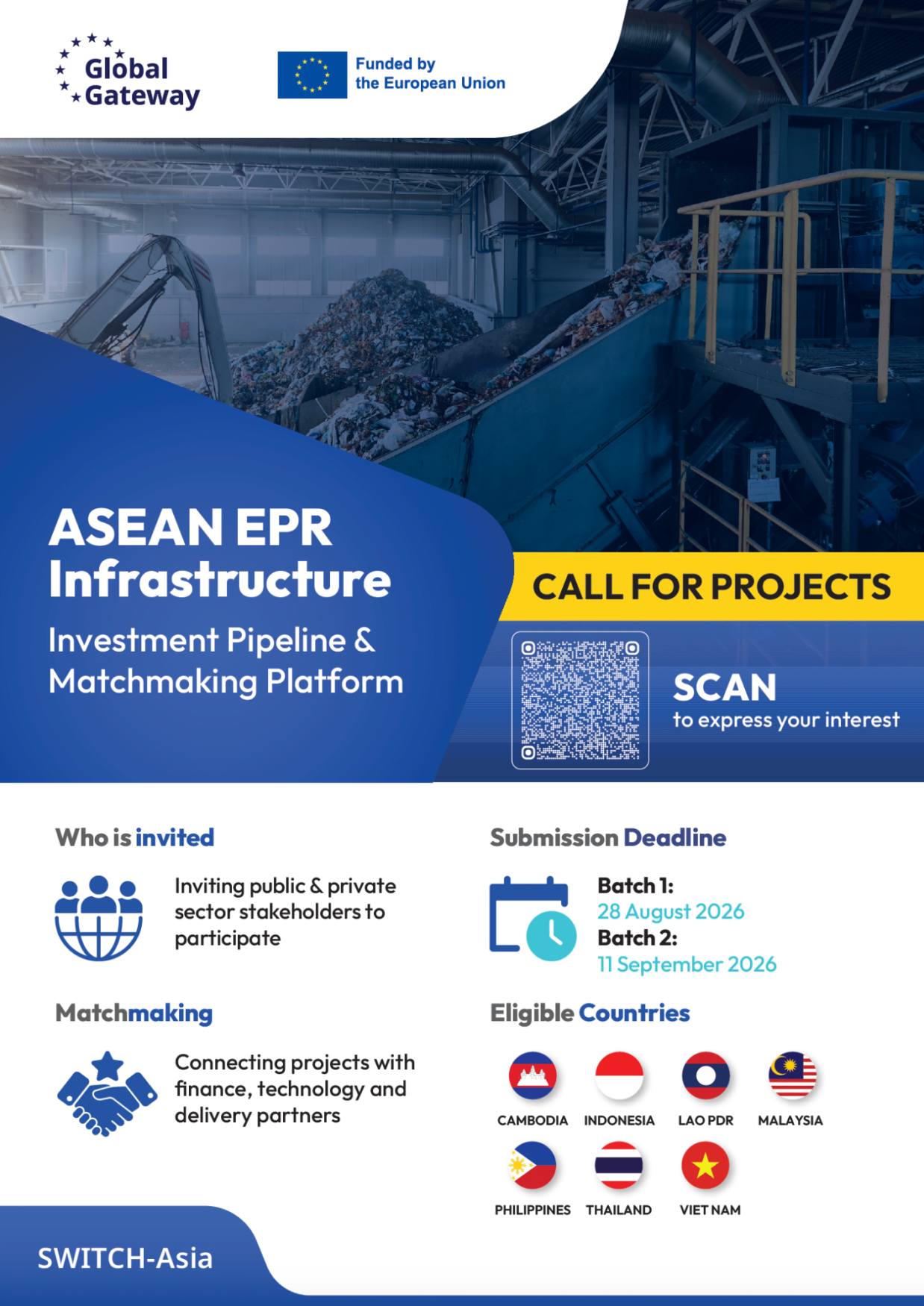
Locations: Cambodia, Indonesia, Laos, Malaysia, Philippines, Thailand, Viet Nam (Ongoing)
Themes: Extended Producer Responsibility (EPR), Circular Economy Finance, EPR Infrastructure Investment
The Challenge
Extended Producer Responsibility (EPR) policies have advanced significantly across Southeast Asia, supported by technical assistance and evolving regional policy frameworks. However, EPR policy maturity varies considerably across the region, ranging from comprehensive laws in Viet Nam and the Philippines to draft regulations and voluntary schemes in Cambodia, Indonesia, Laos, Malaysia, and Thailand.
Despite this policy momentum, a critical gap remains: local municipalities and waste operators face a severe deficit of affordable finance and appropriate technology required to scale up infrastructure. At the same time, European Union (EU) businesses, Development Financial Institutions (DFIs), and impact investors are actively seeking bankable circular economy projects aligned with the EU Sustainable Finance Taxonomy and ASEAN Taxonomy for Sustainable Finance. The pipeline of small-to-medium (€500,000 to €10 million) investment-ready EPR infrastructure projects - such as Material Recovery Facilities (MRFs), rPET mechanical recycling plants, e-waste dismantling, battery collection hubs, and tyre processing - remains underdeveloped. Furthermore, many existing projects fail to satisfy strict taxonomy criteria (e.g., incineration vs. true material recovery), effectively blocking access to green bonds and climate finance.
Objectives
This Technical Advisory (TA), implemented under the SWITCH-Asia Policy Support Component (PSC), aims to accelerate private and blended finance from EU sources into EPR-related infrastructure and circular value chains across target ASEAN countries. Building on SWITCH-Asia’s Phase I EPR policy diagnostics, this TA bridges the gap between policy adoption and investment readiness.
Specifically, the TA aims to identify and screen candidate EPR infrastructure projects from seven ASEAN countries, shortlist taxonomy-aligned, investment-ready projects, and facilitate virtual matchmaking between project sponsors, EU financiers, and technology providers to yield active collaboration discussions. It will also produce investor-oriented synthesis reports to clarify bankability requirements and policy readiness across the region.
Way Forward
The project focuses on four interlinked strands of work:
- Project Scoping, Assessment Tooling, and Revenue Screening: Developing standardized project submission templates and a lightweight assessment scorecard to evaluate taxonomy alignment, investment readiness, and EU interest fit.
- Project Solicitation, Shortlisting, and Portfolio Creation: Engaging directly with national governments, EU Delegations (EUDs), and business networks across the seven target countries to solicit candidate projects. Submissions will be evaluated using the assessment tool to produce a shortlisted portfolio of taxonomy-aligned projects summarized into confidential one-page profiles and anonymized portfolio documents.
- Financier Outreach and Virtual Matchmaking: Launching the project portfolio through a dedicated webinar targeting EU financiers and European Chambers of Commerce members. A matchmaking coordinator will facilitate flexible, bilateral virtual meetings to drive investment and technology collaboration discussions.
- Knowledge Synthesis, Public Reporting: Publishing a public investor-oriented report featuring a regional waste-stream heatmap, anonymized portfolio highlights, an investor bankability checklist, and actionable policy recommendations for host governments and EUDs.
The project will seek to facilitate cross-border investment and technology transfers, supporting ASEAN governments and operators in transforming EPR from a regulatory framework into bankable, taxonomy-aligned infrastructure.
Matchmaking Opportunity
The EU SWITCH-Asia is inviting EPR-related infrastructure projects from public and private sector stakeholders to be considered for financing and technology interest by EU businesses.
Projects are solicited from seven ASEAN countries - Cambodia, Indonesia, Laos, Malaysia, Philippines, Thailand, and Viet Nam - where EPR policies have been implemented voluntarily or mandatorily or are under development. This call responds to the growing needs of the public and private sectors in these countries, which are looking for attractive financing and proven technologies to address growing opportunities in secondary materials and their products especially in the EU markets.
Submissions are welcome from municipalities, government agencies, PROs, waste-management and recycling companies, project developers, manufacturers, industry associations and other organisations advancing circular infrastructure.
EPR infrastructure projects may include collection and source-separation systems, material recovery facilities, recycling and reuse infrastructure, digital traceability, reverse logistics, deposit-return systems and other solutions supporting effective EPR implementation.
Application for Participation
1. Project request forms can be requested by completing the following form (click here)
2. The project proponents will submit a project request document to the SWITCH-Asia. Online guidance for completing the document is available on request.
3. The last date for submitting project proposals is 11 September 2026.
4. All project submissions must be self assessed for compliance with the EU and ASEAN sustainable finance / circular economy taxonomies.
5. Every proposal will undergo two stages of evaluation. The green-lighted proposals will be presented to EU financiers and technology providers. One-one discussions will be pursued where interests match.