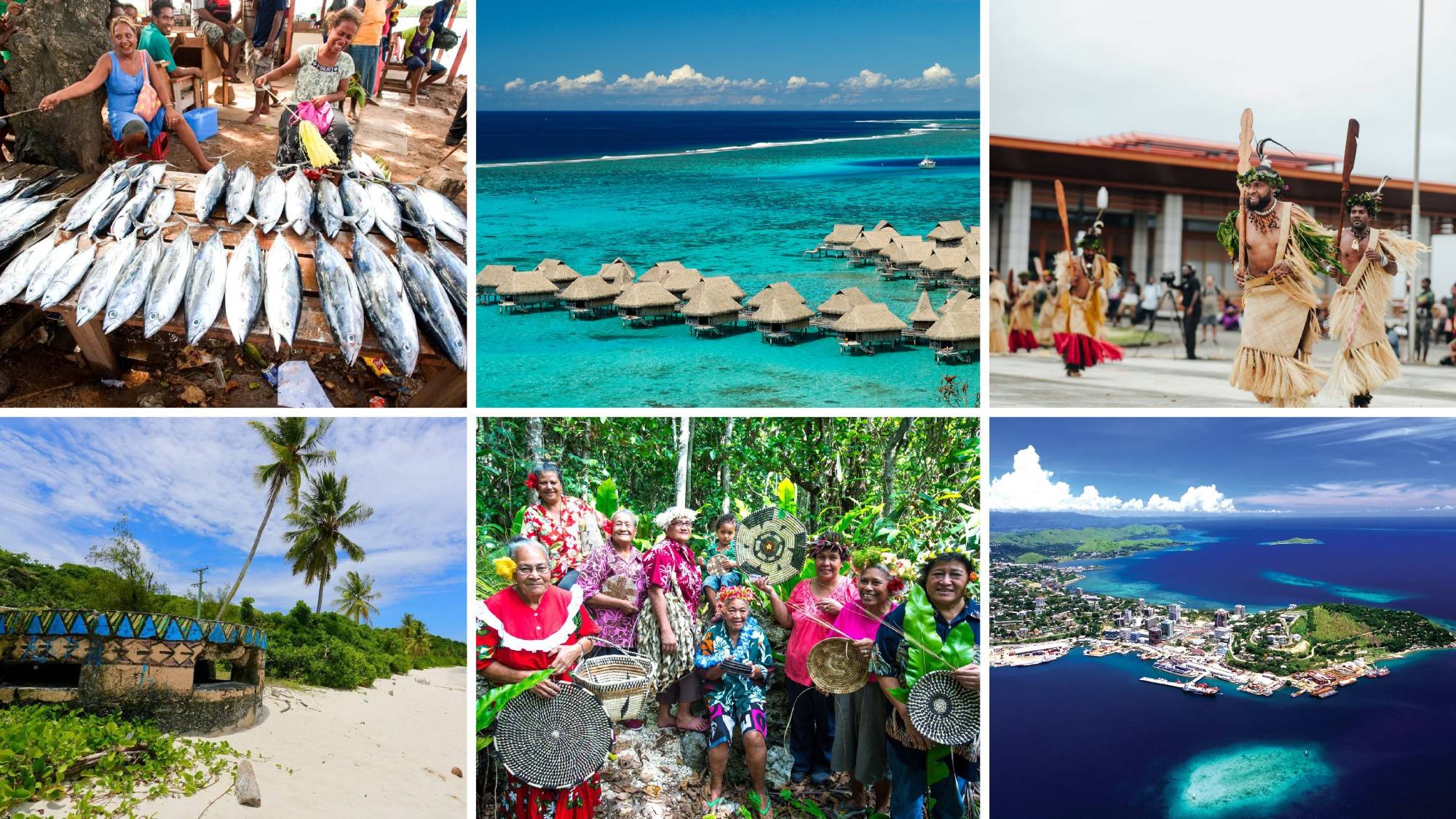
Tourism is one of the Pacific’s important economic sectors. It supports businesses, creates employment, sustains livelihoods and provides opportunities for communities to share their cultures and natural heritage with visitors. Yet the long-term success of tourism depends on protecting the very environmental and cultural assets on which the industry relies.
Across the Pacific, governments and regional organisations have made significant progress in establishing a framework for more sustainable tourism. The challenge now is to translate these commitments into practical changes in the way tourism businesses operate, purchase goods and services, manage resources and engage with local communities.
This is the central message behind the final webinar in the Sustainable Tourism Enhancement in the Pacific (STEP) Regional Learning Exchange Series, “Moving Pacific Tourism Toward Sustainability through Business-Led Supply Chains,” that took place on 12 November 2026. Organised through the Pacific Tourism Organisation (PTO) and the EU SWITCH-Asia Policy Support Component (PSC), the webinar focused on how stronger, more sustainable supply chains can help tourism businesses move from ambition to implementation.
STEP: Building the foundations for sustainable tourism across four Pacific countries
The STEP programme, implemented by PTO and supported by EU SWITCH-Asia PSC, supports the transition towards more sustainable and circular tourism in the Pacific. Building on the Pacific Sustainable Tourism Policy Framework and Pacific Sustainable Tourism Standards, the programme has supported country pathways of Fiji, Kiribati, Samoa and Vanuatu and developed a regional roadmap to integrate Sustainable Consumption and Production (SCP) and Circular Economy principles into tourism development.
STEP has progressed through two interconnected phases, moving from regional and national assessments towards the development and implementation of tourism standards and supporting tools.
Phase I: Scoping assessments and country pathways
The first phase involved in-country consultations in the four demonstration countries: Fiji, Kiribati, Samoa and Vanuatu. These consultations helped identify national priorities, existing capacities and opportunities for integrating sustainable consumption, production and circular economy principles into tourism development.
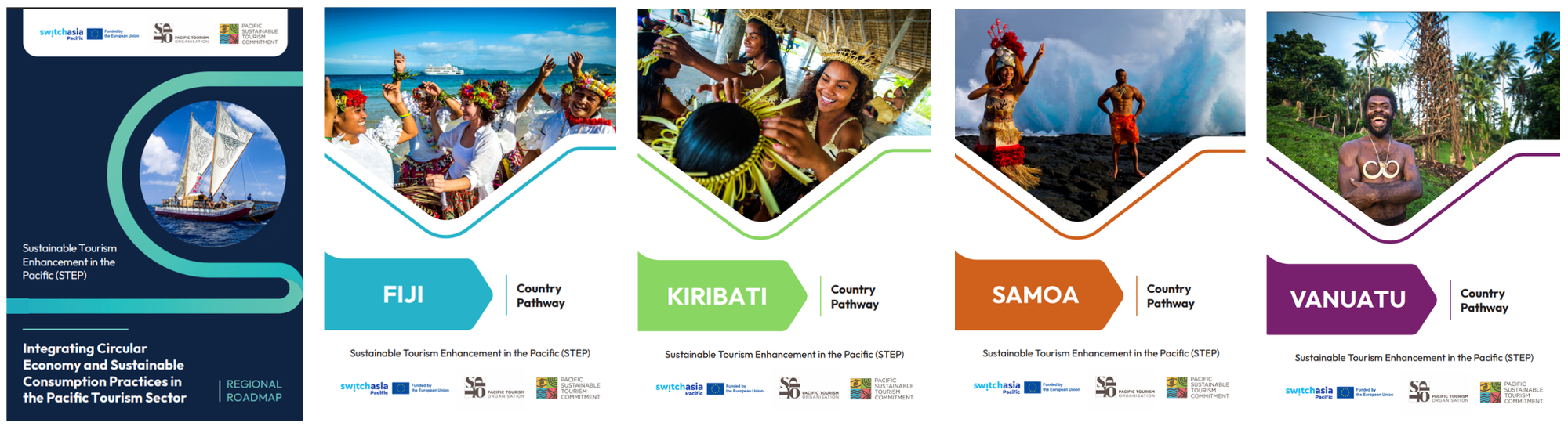
A key outcome was the development and finalisation of the STEP Regional Roadmap and four country pathways. These provide a strategic direction for advancing sustainable and circular tourism while recognising the different national contexts and priorities of each country. Rather than applying a single model across the region, the country pathways reflect the need for approaches that respond to each destination's institutional arrangements, tourism industry structure and local circumstances.
Phase II: Supporting implementation through national tourism standards
Building on the assessments and pathways, the second phase focused on strengthening the policy and regulatory foundations for sustainable tourism. This included updating the national tourism standards in Kiribati, Samoa and Vanuatu, working with Fiji on the development of its new national tourism standards, and developing regional recommendations.
The work in each country has produced distinct outputs:
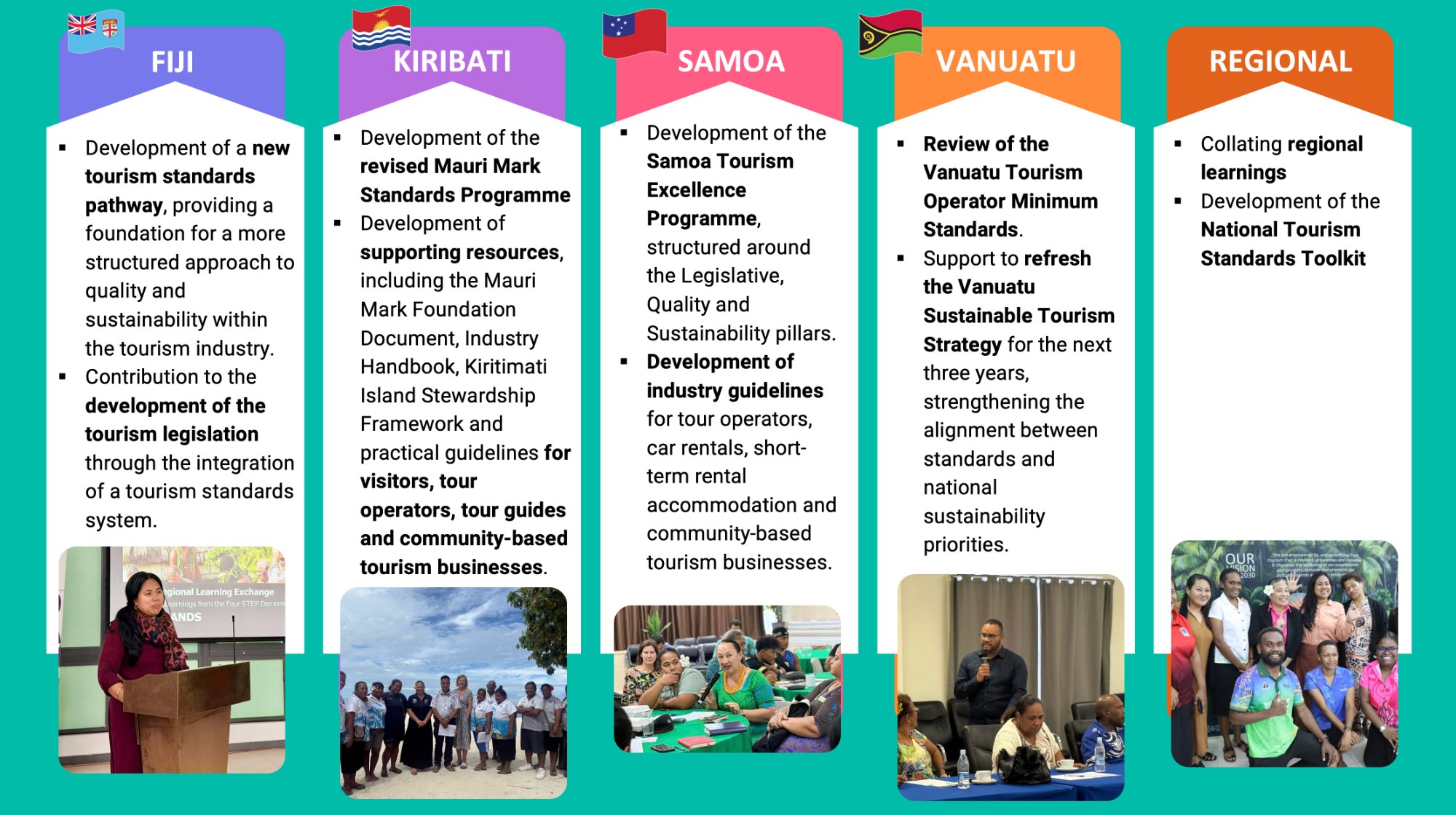
At the regional level, STEP has also worked on consolidating regional learnings and developing a National Tourism Standards Toolkit. The Regional Learning Exchanges Series was also conducted through four webinars that showcased good practices in sustainable tourism, providing opportunities for countries and stakeholders to learn from experiences across the Pacific. Together, these outputs demonstrate how STEP is helping countries move from broad sustainability commitments towards clearer standards, institutional responsibilities and practical guidance for tourism operators.
What the Pacific has learned from the STEP journey
The STEP experience has generated important lessons for future regional cooperation and sustainable tourism development.
 First, stronger regional engagement with tourism standards is essential. Greater engagement across the Pacific can help promote consistency, quality and sustainable tourism development while allowing countries to adapt standards to their own circumstances.
Second, tourism standards can support integrated destination management. Standards are not simply regulatory instruments. They can provide a mechanism for linking sustainability with destination management, marketing, monitoring and performance measurement.
Third, future initiatives should build on existing Pacific leadership. The region already demonstrates strong leadership in sustainable tourism. Rather than seeking perfection from the outset, countries should build on existing strengths and progress from their current position.
Fourth, policy and standards development require adequate time. Effective development depends on consultation and collaboration with countries.
Fifth, diverse technical expertise can strengthen outcomes. Future initiatives can benefit from engaging technical advisers across multiple countries, bringing together different expertise, perspectives and experiences.
Finally, regional peer-to-peer learning needs to be expanded. More opportunities for face-to-face learning and exchange can strengthen collaboration, knowledge sharing and peer support among tourism stakeholders.
These lessons are particularly relevant as the region moves towards the next challenge: ensuring that the standards and pathways developed through STEP translate into changes in business operations and supply chains.
The next challenge: making sustainability work for businesses
Sustainability is ultimately experienced at the operational level: in the products a hotel purchases, the food a restaurant sources, the energy a resort consumes, the waste a tour operator generates and the suppliers a community-based tourism enterprise can access. For many micro, small and medium-sized enterprises (MSMEs), however, adopting sustainable practices is not simply a matter of willingness. Businesses must be able to find suitable products and services, afford them, transport them to their destinations and access the knowledge needed to use them effectively. This is where supply chains become critical.
Tourism businesses across the Pacific face a range of interconnected supply-chain constraints. In smaller island economies and remote destinations, sustainable products and technologies may be difficult to find locally. Businesses may depend on imports, with shipping costs, transport schedules and limited distribution networks increasing the price of alternatives. These challenges can be particularly significant for operators outside major commercial centers and for businesses located on outer islands.
Access to alternatives to single-use plastics is another important concern. Hotels, restaurants and tour operators need practical and affordable options for packaging, water bottles, food service items and guest amenities. Even where alternatives exist, their availability, cost and suitability for local operating conditions can affect whether businesses adopt them.
Other priorities include renewable energy and energy efficiency, water conservation, recycling and waste management, sustainable procurement and improved connections between tourism operators and local food producers. These are not isolated environmental issues. They affect business costs, operational efficiency, product quality, competitiveness and the ability of local enterprises to participate in tourism value chains.
A sustainable tourism transition therefore requires attention not only to what businesses should do, but also to whether the supply systems around them make those changes possible.
Connecting tourism with local producers and suppliers
One important opportunity lies in strengthening links between tourism businesses and local producers. Hotels, resorts and restaurants create consistent demand for food, beverages, furnishings, amenities and other services. Where local farmers, fishers, manufacturers and community enterprises can meet these requirements, tourism expenditure can generate wider economic benefits within destinations. However, establishing these relationships requires more than encouraging hotels to buy locally. Producers need to meet expectations on quality, volume, reliability, pricing, food safety and delivery. Tourism businesses, in turn, need to understand what local suppliers can provide and how procurement arrangements can be adapted to support them.
The Food and Agriculture Organization of the United Nations (FAO), through its work on agricultural development and food systems, offers relevant experience in strengthening producer capacity and market linkages. Bringing these perspectives into tourism discussions can help identify practical ways to connect agricultural supply with the needs of hotels, resorts and restaurants.
Associations and industry networks can also play an important role. By aggregating information on members’ purchasing needs, identifying common requirements and facilitating connections with suppliers, they can help smaller operators overcome some of the limitations of purchasing individually.
The Pacific Asia Travel Association (PATA) also brings a wider regional tourism-industry perspective. Its networks and industry experience can help connect tourism stakeholders, share relevant practices and identify opportunities for knowledge exchange across destinations.
Turning waste reduction into practical action
Reducing plastic pollution and improving waste management are equally important to the future of Pacific tourism. The health of the region’s oceans, coastlines and natural environments is closely connected to the quality of the visitor experience and the livelihoods of coastal communities. There is already a regional foundation on which businesses can build. SPTO and the Secretariat of the Pacific Regional Environment Programme (SPREP), through the Pacific Ocean Litter Project, have worked together to develop standards and a certification programme for phasing out single-use plastics in the Pacific tourism industry. The programme includes practical guidance and a toolkit to help tourism businesses identify alternatives, assess their practices and progressively reduce their reliance on problematic single-use plastic items. This demonstrates how regional policy commitments can be translated into tools that businesses can use. It also highlights the importance of engaging suppliers: hotels and restaurants cannot transition effectively if suitable alternatives are unavailable, unaffordable or difficult to transport. The same principle applies to renewable energy, water efficiency and recycling. Solutions need to be technically appropriate, commercially realistic and accessible to businesses of different sizes.
The role of regional cooperation and investment
No single organisation can address these challenges alone. Sustainable tourism supply chains depend on cooperation between tourism businesses, industry associations, suppliers, technical organisations, governments and development partners. The European Union’s Global Gateway strategy provides a broader framework for considering sustainable infrastructure, connectivity, private-sector development and investment partnerships. In the Pacific tourism context, these priorities can be relevant to discussions on resource-efficient technologies, renewable energy, waste-management systems and stronger market connections. However, moving from technical assistance to investment requires realistic preparation. Businesses need to identify their requirements, understand the costs and benefits of proposed solutions, and assess whether technologies or services are appropriate for their operating conditions. Suppliers need to understand demand and the practical constraints of island markets. Potential partners need to identify where their expertise and existing programmes can complement one another. The objective is not to assume that new financing will automatically become available, but to identify viable opportunities, strengthen business readiness and connect stakeholders who may be able to take ideas forward.
From dialogue to practical partnerships
The STEP final Learning Exchange brought together these perspectives through a conversation that moved from business experience to potential solutions and, finally, to opportunities for collaboration. The business and industry discussion featured perspectives from the Samoa Hotel and Hospitality Association, the Vanuatu Chamber of Commerce and Industry and PATA. The solutions session brought in FAO, SPTO’s Pacific Ocean Litter Project and the EU Delegation to the Pacific. The Webinar identified common challenges, shared practical examples and recognised where existing initiatives and capabilities can complement one another.
Building a more resilient and inclusive Pacific tourism sector
Ultimately, business-led supply chains are about more than improving procurement. They are about ensuring that the transition to sustainable tourism is supported by the businesses, producers and communities that make the sector possible. When tourism operators can access local products, sustainable technologies and reliable services, they are better positioned to reduce environmental impacts while strengthening business performance. When local producers are connected to tourism markets, more economic value can remain within communities. When suppliers and industry networks work together, sustainable alternatives can become more accessible and commercially viable.
For the Pacific, where the natural environment and cultural heritage are central to tourism, this transition is particularly important. Sustainable tourism must protect ecosystems, strengthen local livelihoods and contribute to long-term climate resilience and economic development. Through its two-phased journey, STEP has developed regional pathways, supported Fiji, Kiribati, Samoa and Vanuatu in strengthening national tourism standards, improving implementation guidance, and capturing lessons that can benefit the wider Pacific. The experience also demonstrates that meaningful progress requires country ownership, sufficient time, technical expertise and continued regional collaboration. The next step is to connect these foundations to the realities of business operations and supply chains.
The future of sustainable Pacific tourism will depend not only on the standards the region adopts, but on the partnerships it builds and the practical choices businesses are enabled to make every day.
References:
The article draws on the STEP webinar, supplemented by the following regional sources:
- STEP Regional Roadmap and Country Pathways – SPTO, October 2025: Pacific Tourism Leaders Launch Regional Roadmap and Country Pathways for Sustainable and Circular Tourism.
- STEP programme background – SPTO: Sustainable Tourism Enhancement in the Pacific (STEP) Project.
- Single-use plastics standards and certification – SPTO: Standards and Certification Programme for Phasing Out Single-Use Plastics.
- Practical implementation toolkit – SPTO: Toolkit for Phasing Out Single-Use Plastics in the Pacific Tourism Industry.
- Regional industry example – SPREP, March 2026: South Pacific Tourism Exchange 2026 commits to single-use plastic-free event.