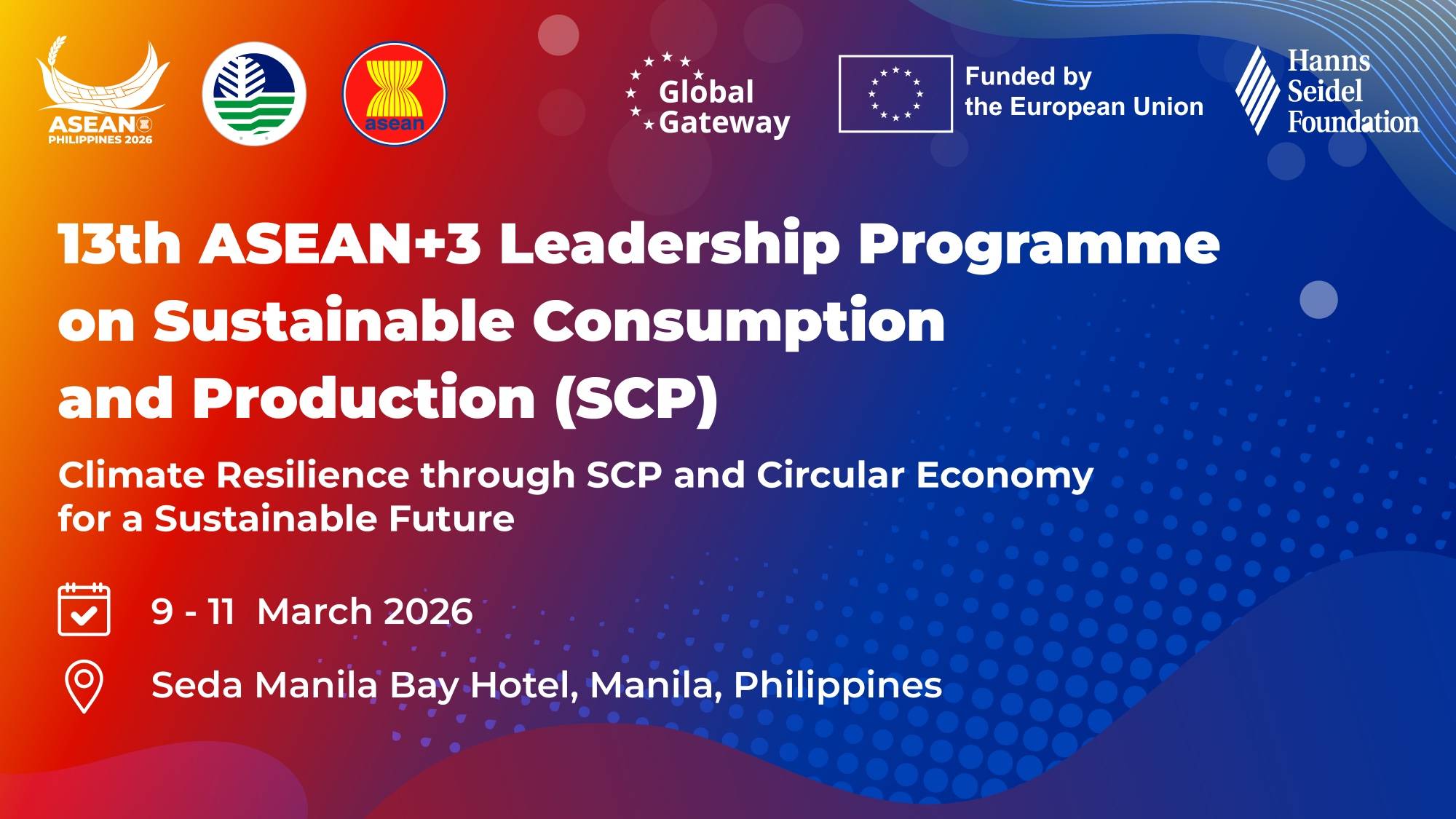
WHEN: 9-11 March 2026 I TIME: 8:00-17:30 (GMT+8) I VENUE: Seda Marina Bay Hotel, Manila, Philippines
Background
The ASEAN-Plus-Three (ASEAN+3) Leadership Programme (LP) on Sustainable Consumption and Production (SCP) was launched in 2008 within the framework of the ASEAN Environmental Education Action Plan (AEEAP) (2008-2014) which was endorsed by the Governments of ASEAN Member States. The event aims to enhance the capacity of policymakers by focusing on the development and implementation of SCP-related policies, as well as the mainstreaming and scaling-up of SCP practices. The ASEAN+3 LP was hosted during 2008-2019 annually by the ASEAN Environment Ministries in coordination with the ASEAN Secretariat (ASEC) and the ASEAN Member States (AMS) through the ASEAN Working Group on Environmental Education (AWGEE), which is the main responsible body for implementation of the programmes and activities related to SCP. Previous partner organisations of the programme are as follows: the United Nations University-Institute for the Advance Study on Sustainability (UNU-IAS), United Nations Industrial Development Organisation (UNIDO), United Nations Environment Programme (UNEP), the Hanns Seidel Foundation, the Ministry of the Environment of Japan, and the European Union through the SWITCH-Asia Programme.
The previous 12th ASEAN+3 Leadership Program on SCP held in 4-6 November 2024 in Lao PDR was hosted by the Ministry of Natural Resources and Environment (MoNRE) of Lao PDR, with support from the EU SWITCH-Asia Policy Support Component, the EU Delegation to Lao PDR and ASEAN, and the Hanns Seidel Foundation – Vietnam.
In the 17th Meeting of AWGEE in 2-3 July 2025 in Manila Philippines, it was decided that any AMS interested to host the 13thASEAN+3 LP on SCP to inform ASEC and to coordinate closely with EU-SWITCH-Asia, who expressed continued support on delivering the next Leadership Programme. On August 19, 2025, the Department of Environment and Natural Resources (DENR), Philippines has formally informed the ASEC their interest to host the 13th ASEAN+3 LP on SCP to take place tentatively on March 2026, as part of their upcoming 2026 ASEAN Chairmanship.
The urgency of addressing climate change underscores the critical role of SCP and Circular Economy (CE) in shaping resilient and low-carbon societies. As ASEAN and its Plus Three partners strive to advance sustainable growth, SCP offers a practical pathway to reduce greenhouse gas emissions across key sectors, including energy, transport, food systems, and industry. Integrating climate change considerations into SCP practices can accelerate the transition toward a circular economy, promote resource efficiency, and enhance climate-resilient production and consumption patterns. This alignment supports the ASEAN Community Vision 2045 and contributes to regional commitments under the Paris Agreement and the UN 2030 Agenda for Sustainable Development, particularly SDG 12 (Responsible Consumption and Production) and SDG 13 (Climate Action).
By integrating Climate Change into SCP leadership discussions, the Programme will strengthen policy alignment on Climate Change, SCP and CE at national and regional levels, promote cooperation on initiatives with measurable climate benefits, and support actionable recommendations linking SCP implementation with climate strategies under the ASEAN+3 framework.
With the theme “Climate Resilience through SCP and Circular Economy for a Sustainable Future,” the 13th ASEAN+3 LP on SCP continues its tradition of embedding learning across all sessions. It highlights how material use, and climate concerns are inseparably linked—showing that smarter resource management and circular practices are also critical pathways to building resilience. The programme equips policymakers with the knowledge, tools, and regional perspectives to apply a climate lens when translating SCP and circular economy ambitions into practice.
The 13th ASEAN+3 Leadership Programme on SCP
As part of the activities supported by Philippines in its upcoming 2026 ASEAN Chairmanship, the 13th ASEAN+3 Leadership Programme (LP), provides a unique opportunity to place climate change as the headline agenda - framing SCP and CE not only as development tools but as urgent enablers for mitigation, adaptation, and resilience in the face of climate change. This aligns with ASEAN regional commitments under the ASEAN SCP Framework, the ASEAN Circular Economy Framework, and international commitments including the Paris Agreement, the SDGs, and the outcomes of the UNFCCC COP process.
The Philippines, as one of the climate-vulnerable countries in the world, is at the forefront of advancing policies that integrate climate change action with sustainable consumption and production (SCP) and circular economy (CE) strategies. With recent milestones such as the Extended Producer Responsibility (EPR) Act of 2022, progressive eco-labelling initiatives, and strengthening of green public procurement (GPP), the Philippines demonstrates leadership in building systemic SCP and CE solutions to climate risks.
The 13th ASEAN+3 Leadership Programme on SCP will be held on 9-11 March 2026 at Seda Manila Bay Hotel, Manila, Philippines, hosted by the Department of Environment and Natural Resources (DENR) Philippines, with support from the EU SWITCH-Asia Policy Support Component (PSC), the Delegation of European Union to Philippines through its country programmes, the EU Delegation to ASEAN in coordination with the ASEAN Secretariat.
The thematic focus of the 13th ASEAN+3 LP on SCP will be on “Climate Resilience through SCP and Circular Economy for a Sustainable Future.”
Objectives
To provide a platform for ASEAN+3 policymakers to exchange experiences, innovative practices, and actionable policy pathways for embedding climate action within SCP and CE strategies—ensuring concrete takeaways for implementation at national and regional levels.
- Align SCP, CE, GPP, and EPR with Climate Policies: Strengthen policymakers’ capacity to align SCP, CE, GPP, and EPR with national climate policies to drive integrated resilient strategies aligned with Paris Agreement and SDG 12 commitments.
- Promote Business Engagement and Innovation for Integration of SCP, CE and Climate Action: Enhance regional and national policy coherence while showcasing business models, financing mechanisms, and partnerships that support low-carbon, resource-efficient, and climate-resilient economies.
- Strengthen Regional Collaboration for Policy Integration: Foster ASEAN+3 cooperation on knowledge exchange, and peer learning to accelerate climate-aligned SCP and CE practices.
Expected Outcomes
- Building a Shared Understanding of How SCP and CE Advance Climate Mitigation, Adaptation, and Resilience through Policy Alignment at national levels with ASEAN frameworks and global climate goals.
- Learnings from policy implementation tools, embedding GPP, EPR among others, business cases, and financing pathways as climate action instruments across ASEAN+3.
- A network of empowered policymakers acting as champions for integrating climate priorities into SCP and CE strategies.
Target Audience
The target participants (in person and on-line) for the ASEAN+3 Leadership Programme are mainly government policy makers from the ASEAN Member States and three ASEAN dialogue partner countries - China, Japan, and the Republic of Korea.
The 13th ASEAN+3 LP will also request the participation of mixed inter-ministerial delegations from each ASEAN Member State, to highlight the cross-cutting nature of SCP and its linkages to climate change. These participants are:
- Designated Officials directly engaged in climate change policy, business and industrial policy, and circular economy priorities - especially in the areas of GPP, EPR, which are central to the LP discussions.
- ASEAN Senior Officials on Environment (ASOEN) National Focal Points or their representatives; and ASOEN counterparts or their representatives from China, Japan and Republic of Korea
- National Focal Points in Southeast Asia of the SWITCH-Asia Programme’s Policy Support Component on Sustainable Consumption and Production.